Masson’s Dating
David Parkes Masson (1847-1915) was a most assiduous and careful collector of Kashmir covers “as they were happening.” His dating conversions from the Persian are seen in his distinctive hand in red ink. Some of his conversions are defiantly at odds with the evidence of the British date stamps, which leaves us with a intriguing puzzle. There are, in fact, many cases in which Masson’s conversion puts the despatch date after the delivery date:

Our utility converts “11th Assu” to 25 September, with comfort from the cds. The inconsistecy by almost a week was certainly evident to him, but it clearly did not concern him for some good reason. What was it? Detail, Lot 183 Sturton (“Blue”) Sale.

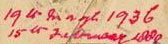
On these two examples, Masson’s conversion dates were again 6 and 10 days past the delivery date as given by British date stamps. Another little peculiarity shows up in the table below with the pair of covers having Masson assignments 16 & 17 Phagan 1924. He does convert these to successive days, but backward running: 26 & 25 February 1868, respectively.
Examples of Masson’s datings are gathered below (data collection for now). One feature that shows up immediately is that the discrepancies are of markedly different duration, from near perfect agreement to differences one way or the other of (so far) up to 16 days. We begin to feel that these shifts are an artifact of a parallel lunisolar convention, which Masson wished to keep tabs upon for some reason, whereas the postal system adhered to the pure solar convention. How we describe the discrepancies in our table can be seen in the following examples:

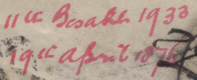
For the detail on the left, our conversion utility gives 18 November in place of Masson’s 27 November, and we call that a “+9 day” difference because Masson’s reckoning is later by 9 days. Similarly, the detail on the right converts to 21 April on the utility, thus a “−2 days” would be recorded in the table.
| Masson Date | Masson Conv. | Utility | Δ(days) | Source |
|---|---|---|---|---|
| 9 Assu 1923 | 3 Oct 1866 | 23 Sep 1866 | +10 | S&M Plate 11 |
| 5 Maghar 1923 | 27 Nov 1866 | 18 Nov 1866 | +9 | — |
| 20 Magh 1924 | 29 Jan 1868 | 1 Feb 1868 | −3 | — |
| 16 Phagan 1924 | 26 Feb 1868 | 26 Feb 1868 | 0 | Eames #149 |
| 17 Phagan 1924 | 25 Feb 1868 | 27 Feb 1868 | −2 | — |
| 10 Maghar 1925 | 10 Nov 1868 | 23 Nov 1868 | −13 | Harell |
| 1 Har 1929 | 22 Jun 1872 | 13 Jun 1872 | +9 | — |
| 25 Katak 1929 | 10 Nov 1872 | 8 Nov 1872 | +2 | — |
| 29 Maghar 1929 | 14 Dec 1872 | 12 Dec 1872 | +2 | — |
| 30 Bhadon 1931 | 25 Sep 1874 | 13 Sep 1874 | +12 | Harell |
| 5 Bhadron 1932 | 22 Aug 1875 | 19 Aug 1875 | +3 | Hellrigl #90 |
| 9 Besakh 1933 | 17 Apr 1876 | 19 Apr 1876 | −2 | Haverbeck #1351 |
| 11 Besakh 1933 | 19 Apr 1876 | 21 Apr 1876 | −2 | — |
| 5 Bhadon 1933 | 10 Aug 1876 | 19 Aug 1876 | −9 | — |
| 10 Assu 1933 | 13 Sep 1876 | 24 Sep 1876 | −11 | Harell |
| 18 Katak 1933 | 21 Oct 1876 | 1 Nov 1876 | −11 | — |
| 2 Har 1934 | 27 Jun 1877 | 14 Jun 1877 | +13 | Eames #152 |
| 1 Bhadon 1934 | 24 Aug 1877 | 15 Aug 1877 | +9 | — |
| 11 Assu 1934 | 3 Oct 1877 | 25 Sep 1877 | +8 | Sturton #183 |
| 16 Assu 1934 | 8 Oct 1877 | 30 Sep 1877 | +8 | Sturton #192 |
| 22 Assu 1934 | 14 Oct 1877 | 6 Oct 1877 | +8 | Hellrigl #60 |
| 24 Assu 1934 | 16 Oct 1877 | 8 Oct 1877 | +8 | Hellrigl #59 |
| 5 Magh 1934 | 24 Jan 1878 | 16 Jan 1878 | +8 | Hellrigl #57 |
| 27 Magh 1934 | 16 Feb 1878 | 7 Feb 1878 | +9 | Sturton #184 |
| 5 Phagan 1934 | 22 Feb 1878 | 15 Feb 1878 | +7 | ex Mix |
| 11 Jeth 1935 | 27 May 1878 | 23 May 1878 | +4 | Harell |
| 2 Chet 1935 | 20 Mar 1878* | 13 Mar 1879 | +7 | Masson II p.12 |
| 6 Chet 1935 | 24 Mar 1878* | 17 Mar 1879 | +7 | Masson II p.12 |
| 26 Chet 1935 | 13 Apr 1878* | 6 Apr 1879 | +7 | Haverbeck #1281 |
| 3 Har 1935 | 7 Jun 1878 | 15 Jun 1878 | −8 | — |
| 19 Magh 1936 | 15 Feb 1880 | 30 Jan 1880 | +16 | — |
| 15 Chet 1936 | 23 Mar 1879* | 26 Mar 1880 | −3 | Jaiswal 10318 |
| 22 Chet 1936 | 30 Mar 1879* | 2 Apr 1880 | −3 | Jaiswal 10319 |
| 12 Poh 1937 | 28 Dec 1880 | 24 Dec 1880 | +4 | Harell (Poonch) |
| 9 Bhadon 1938 | 18 Aug 1881 | 23 Aug 1881 | −5 | Harell (Poonch) |
| 21 Assu 1938 | 29 Sep 1881 | 5 Oct 1881 | −6 | — |
| 30 Katak 1938 | 6 Nov 1881 | 13 Nov 1881 | −7 | Sturton #309 |
| 26 Besakh 1939 | 29 Apr 1882 | 7 May 1882 | −7 | Harell |
| 1 Jeth 1939 | 4 May 1882 | 13 May 1882 | −9 | — |
| 24 Jeth 1939 | 25 Jun 1882 | 5 Jun 1882 | +20 | — |
| 26 Assu 1939 | 23 Oct 1882 | 9 Oct 1882 | +14 | Jaiswal 10422 |
| 14 Phagan 1939 | 7 Mar 1883 | 24 Feb 1883 | +11 | Harell |
| 24 Chet 1939 | 28 Mar 1882* | 4 Apr 1883 | −7 | Jaiswal 10420 |
| 22 Katak 1940 | 7 Nov 1883 | 6 Nov 1883 | +1 | Harell (Poonch) |
* An asterisk on certain of Masson’s AD-conversions reflects his taking chet (our ćait) to be the first month of the Hindu year in question (a luni-solar convention), not the last month of the preceding year (the solar convention as used by the post office). Our conversions of those particular dates are thus about a year later, and arguments as to why each tallies with reality (so far as the year goes) are given in the Calendar Conversion link at top of this screen.
Dates in manuscript become scarce in the New Colors period, and we have yet to see a Masson at all. The collection of dates in the table is yet too sparse for obtaining an instructive graph; we should one day like to see how the two systems go into and out of phase with each other. There may not be enough examples ever to do so.

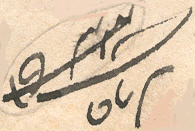
By the way, in cursive writing ćait and jeţh can be difficult or impossible to tell apart. Both are often rendered by a simple undotted hook and completed with an uninterrupted flourish. On the left is ćait 1936, and on the right is 2 māh jeţh 1933, both with cover corroboration. Other pairs of months can be confused as well in rapid cursives, such as even māgh and baisākh.
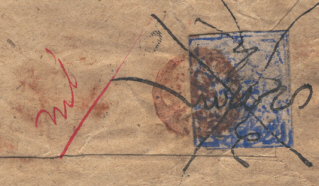
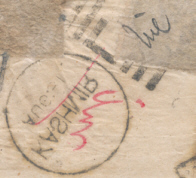
Another by the way: The hitherto mysterious “nil” that is seen on many a cover in red ink has been rendered unmysterious by Anthony Bard. It was Masson’s notation to indicate that the cover had no date to be deciphered from the Persian. The earliest and latest “nil” that we have seen is from 1866 and 1886. So we might expect actual Masson datings up to at least 1886. So far we go only into late 1883. The years 1884-85 seem rather barren of covers anyway (relatively speaking), so finding one might take some time.
Appendix: Some Lunisolar Complications
In the hybrid lunisolar calender mayhem occurs when two new moons occur within a solar-designated month, something that occurs about once every three years. It seems in effect to cause the afflicted month to “start early,” sometimes considerably so. We quote the alarming lines from Platts p 398 quoting Forbes: “Hence although the month baisākh begins de jure about the 11th of April, it may have commenced de facto from one day to twenty-eight days sooner,” depending on when its first full moon occurs. Other complications arise when accurate daily conversions are to be achieved for a particular location. If you lurk in dictionaries you might also have encountered terms referring to certain intercalary months that are potential disturbances to the system, such as bīsondh and adhimās ~ half-month. The former is of 20 days duration in which money-lenders did not charge interest; the latter, usually of 11 days, comprised the omitted days between the end of the lunar year and the start of the solar year.
Another complicating issue comes in another footnote (Masson II, page 1):
“. . . In some cases I may still be fourteen days ‘out’ in transposing the Christian dates for the Hindu ones. This is due to the Hindu month being divided into halves, shudi and badi, and the envelopes not showing in which half of the month the letters were written. Thus an envelope may bear the date 1st poh 1923; this might mean 1st poh badi, corresponding to our 22nd December 1866, or 1st poh shudi, answering to our 6th January 1867.”
By the way, our utility conversion for 1 poh 1923 is 14 December 1866, which represents an eight-day discrepancy in itself. The 6 January 1867 corresponds to 24 poh 1923 on our utility.
Appendix: Masson Letter
For want of a natural place on the site to put the following bit of Massoniana, we include it here. It is an item of his stamp correspondence, written after on 29 September 1899 at Murree on office stationery. Well, it is said he was a managing-director of the place, and the paper stock was to become defunct in a few weeks anyway.

Murree, 29/9/99 My dear [—], Those are both good stamps. I would have offered Rs25 or so for them, but I did not want to spoil Stewart-Wilson’s chances as he too was negociating. The square is the Jammu blue ½ anna — 72, 74, 76. — and the circular the 1 anna [read 4 annas] 1866 — 19, 20. I willingly paid Rs35/ for a similar find; the circular was a good deal better, and the rectangular not so good. The circular is by far the rarer stamp. Both are genuinely used. Always delighted to “vet” Kashmir stamps. with our united [...test?] regards to you both Im always sincere...

